Stop Building, Start Validating: A 5-Step Guide for Founders
Stop Building, Start Validating: A 5-Step Guide for FoundersThe most expensive mistake a founder can make is writing code too soon.In the early days of a startup, code is a...
 NorthPeak Technologies
The most expensive mistake a founder can make is writing code too soon.
In the early days of a startup, code is a liability, not an asset. Every feature you build without proof is a bet you can’t afford to lose. We often believe that building the product is the first step toward success — but it isn’t.
The first step is validation. If you haven’t proven that your solution solves a painful, urgent problem for a specific group of people, you aren’t building a startup; you’re building a hobby. Here is how to validate your idea before you spend a single dollar on development.
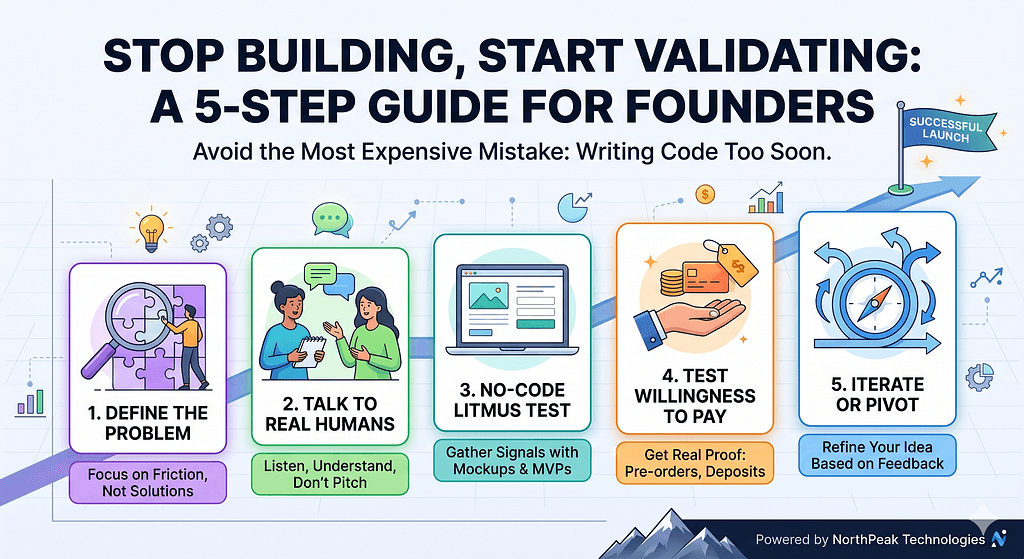
1. Define the Problem (Not the Solution)
Before you think about features, focus on the friction. Most founders fall in love with their “solution,” but successful founders fall in love with the problem. Ask yourself:
- Who is the person in pain?
- How often do they feel this pain?
- How are they currently duct-taping a solution together?
If the problem isn’t clear, your solution will never find a home.
2. Talk to Real Humans
Surveys are easy; conversations are hard. This is where most founders fail. You need to reach out to your target audience and listen. The Rule: Your goal is to understand, not to pitch.
- Don’t ask: “Would you use this app?” (People will lie to be nice).
- Do ask: “Tell me about the last time you dealt with [Problem]. What was the hardest part about it?”
3. The “No-Code” Litmus Test
You don’t need an engineering team to test an idea. You need a signal. Before you hire a developer, try one of these:
- A High-Conversion Landing Page: Use it to collect emails for a “waitlist.”
- Interactive Mockups: Use tools like Figma to show users how it would work.
- The Concierge MVP: Manually perform the service for a customer yourself before you ever automate it with software.
4. Test the “Willingness to Pay”
Validation only counts when there is skin in the game. A “this is a great idea” from a friend is a false positive. Real validation happens when:
- Someone gives you their email address.
- Someone gives you their time for a second meeting.
- Someone gives you their credit card information. Even a $5 pre-order is worth more than a thousand “likes” on social media.
5. Iterate or Pivot
Validation isn’t a one-and-done task; it’s a cycle. Use the feedback from your tests to refine your idea. If users are confused, simplify. If they aren’t interested, pivot. It is significantly cheaper to change a Figma design than it is to rewrite a backend architecture.
How We Move Fast at NorthPeak Technologies
At NorthPeak Technologies, we don’t just build apps; we build businesses. We act as a strategic partner to ensure you aren’t just launching — you’re landing.
We help founders navigate the “Validation Gap” by:
- Distilling vague ideas into actionable hypotheses.
- Profiling target users to find your “Early Evangelists.”
- Architecting lean MVPs that prioritize learning over bloat.
Once an idea is validated, the development process becomes faster, safer, and far more effective.
Final Thought
Don’t fall in love with your idea. Fall in love with the person whose problem you are solving. Ideas are cheap, and code is expensive. Validated ideas are where real startups begin.
Is your idea ready for the real world? If you have a vision but aren’t sure how to prove it works, let’s build a roadmap together.
Ready to Build Your Product?
Book a free consultation. We'll review your idea and give you a clear roadmap to launch — in 4 weeks, not 4 months.