The 20-Agent Chaos: Why “Vibe Operations” Fail Without an Enterprise Ontology
Silicon Valley is currently obsessed with a new milestone: single engineers orchestrating up to twenty autonomous AI agents simultaneously to manage, scale, and monitor enterprise systems around the clock. It...
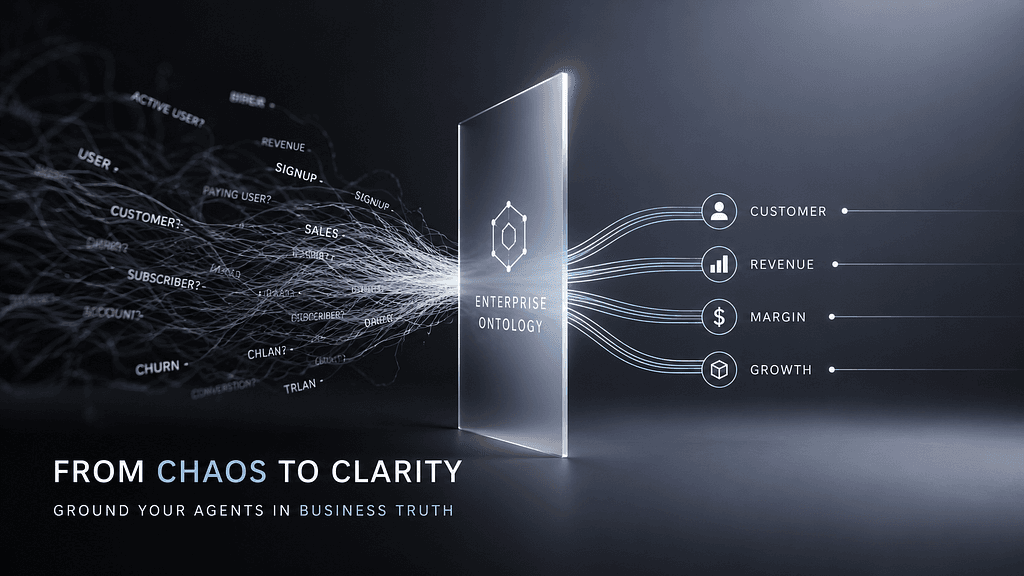
 NorthPeak Technologies
Silicon Valley is currently obsessed with a new milestone: single engineers orchestrating up to twenty autonomous AI agents simultaneously to manage, scale, and monitor enterprise systems around the clock. It looks like ultimate leverage on a podcast demo.
But in real-world production, this hyper-automation is triggering an unprecedented architectural crisis: Semantic Drift.
When you hook twenty independent AI agents into a legacy infrastructure, they don’t just execute your commands — they begin talking to each other. And without a shared, immutable source of business truth, that conversation quickly degrades into an expensive, chaotic game of digital telephone.
1. The Rise of the 20-Agent Conductor
We have officially moved past the era of the isolated AI chatbot. The default engineering stack of 2026 is Agentic Parallelism — deploying specialized subagents that handle code generation, database tuning, security scanning, and product analytics in parallel.
The developer is no longer a writer of syntax; they are a Systems Conductor.
On paper, this shift increases operational velocity by orders of magnitude. A small engineering outfit can ship features at a pace that used to require a massive departmental budget. However, this velocity creates a severe structural blind spot. Each agent operates using its own probabilistic weights and isolated context window.
When Agent A (the data extractor) hands off a vague payload to Agent B (the financial modeler), the system relies on a dangerous assumption: that both agents understand your business terms exactly the same way.
2. The Invisible Threat: Semantic Drift
In a standard data pipeline, information is rigid, predictable, and typed. A database schema ensures that an integer is an integer and a string is a string. But when autonomous agents mediate your operations, the primary medium of exchange becomes unstructured natural language.
This is where Semantic Drift occurs.
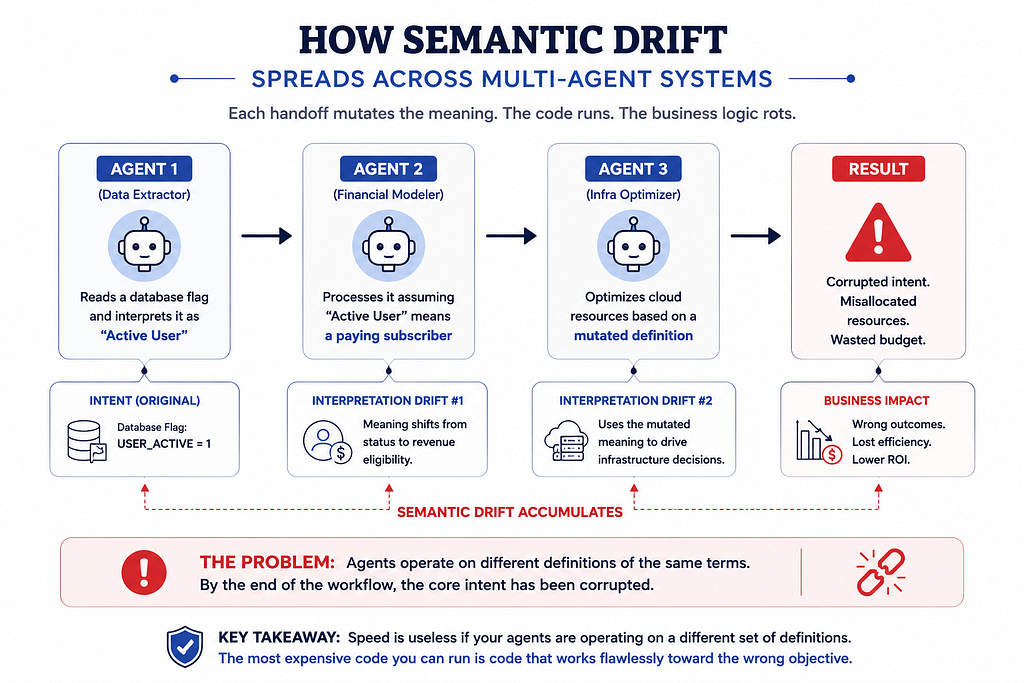
As illustrated in the diagram above, look at what happens when ungrounded context moves across an uncoordinated multi-agent network. Each hop introduces a slight statistical variation in interpretation:
- Agent 1 reads a database flag and interprets it as "Active User".
- Agent 2 takes that output and processes it under the assumption that "Active User" means a paying subscriber.
- Agent 3 takes Agent 2’s calculation and uses it to optimize cloud server infrastructure, completely misallocating resources based on a mutated definition.
By the time the workflow completes its cycle, the core intent has been corrupted. The code runs without throwing a single traditional syntax error, but the business logic has completely rotted. This is the failure of “Vibe Operations” — building highly automated systems on loose, ungrounded descriptions rather than strict, programmatic realities.
“Speed is a liability if your agents are operating on a different set of definitions. The most expensive code you can run is code that works flawlessly toward the wrong objective.”
3. The Solution: Grounding AI with an Enterprise Ontology
To prevent semantic drift from bankrupting your cloud budget, your architecture must implement a centralized Semantic Layer, also known as an Enterprise Ontology.
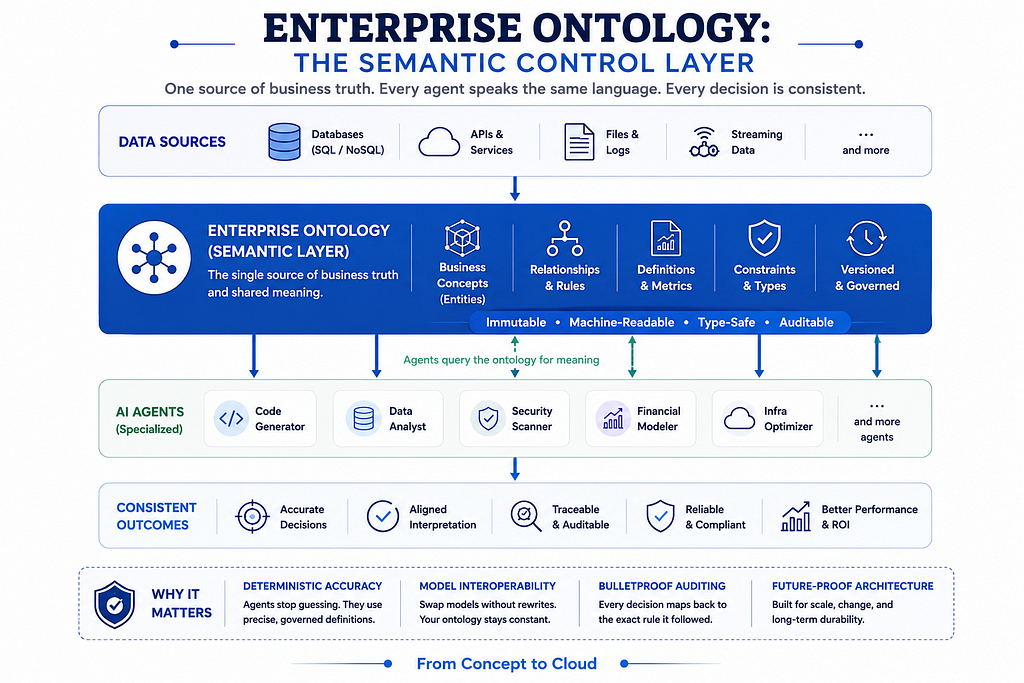
An ontology is an explicit, machine-readable specification of your business domain. It acts as the ultimate translation dictionary that sits between your messy, underlying databases and your autonomous AI agents.
As shown in this architectural blueprint, the semantic layer forces every agent to map its natural language requests back to an immutable, type-safe registry of business concepts.
If an agent wants to calculate “Revenue,” it cannot guess the definition based on raw SQL tables. It must query the ontology, which provides a strict mathematical and logical definition: [Gross Sales] - [Refunds] - [Tax].
By introducing a semantic layer, you unlock three critical advantages:
- Deterministic Accuracy: Agents stop guessing column names or hallucinating metrics because the data models are explicitly defined and grounded.
- Model Interoperability: You can switch between frontier models (OpenAI, Claude, Gemini) effortlessly. Your agents don’t rely on the unique prompting quirks of a specific model; they rely on the permanent infrastructure of your ontology.
- Bulletproof Auditing: Every decision made by an autonomous agent can be traced directly back to the exact ontological rule it followed, providing the total visibility required for modern compliance.
4. Why NorthPeak Technologies Builds for Semantic Permanence
At NorthPeak Technologies, we refuse to build fragile software that depends on the shifting sands of AI hype. We treat machine intelligence as a powerful accelerator, but we anchor it to rigid, production-ready engineering fundamentals.
When we guide founders from Concept to Cloud, we build “Ontology-First” architectures that ensure absolute technical sovereignty:
- Type-Safe Grounding: We leverage deep TypeScript monorepos and clean enterprise schemas to ensure your data pipelines are perfectly structured before an agent ever touches them.
- Decoupled Intelligence: We implement modular strategy patterns, ensuring your business logic is entirely independent of any single third-party AI provider.
- Radical Technical Honesty: If your current team is trying to automate your workflow without a centralized semantic layer, we will tell you directly why it will fail at scale. We prioritize long-term durability over a flashy weekend demo.
The Bottom Line
The future of software engineering isn’t about writing fewer lines of code; it’s about managing greater architectural complexity. The companies that will dominate the late 2020s are those that understand that as code becomes a cheap, automated commodity, clean data structures and explicit business logic are the only true competitive moats. Stop letting your agents guess your business rules. Build an unshakeable, production-ready foundation that keeps them grounded.
Is your operational stack built to survive the agentic era? At NorthPeak Technologies, we engineer the high-performance, resilient, and cutting-edge cloud infrastructure required to scale your vision globally. Let’s design your foundation.
https://www.northpeaktechnologies.com/
Ready to Build Your Product?
Book a free consultation. We'll review your idea and give you a clear roadmap to launch — in 4 weeks, not 4 months.