The Death of the App: Welcome to the Era of Just-in-Time UI
The tech industry just witnessed a quiet seismic shift. At major developer conferences in mid-2026 — most notably Microsoft’s unveiling of its agent-first operating platform, Project Solara — the verdict...
 NorthPeak Technologies
The tech industry just witnessed a quiet seismic shift. At major developer conferences in mid-2026 — most notably Microsoft’s unveiling of its agent-first operating platform, Project Solara — the verdict became official: The traditional application model is dying.
For nearly two decades, the digital economy ran on a simple paradigm: “There’s an app for that.” We built distinct, isolated software packages with rigid menus and static buttons, forcing human users to toggle between different interfaces to achieve a single real-world goal.
We are moving away from software you open, and moving toward intelligence you invoke. We are entering the era of the Just-in-Time User Interface (JIT-UI), where static applications are replaced by dynamic, ephemeral interfaces generated on the fly by autonomous agent networks.
If you are still designing your startup or enterprise around a standard, hard-coded mobile or web app layout, you are building for a landscape that is actively disappearing.
1. The Architecture of the Post-App Interface
To understand how software functions when the fixed interface evaporates, we have to look beneath the surface at how modern cognitive frameworks are structured.
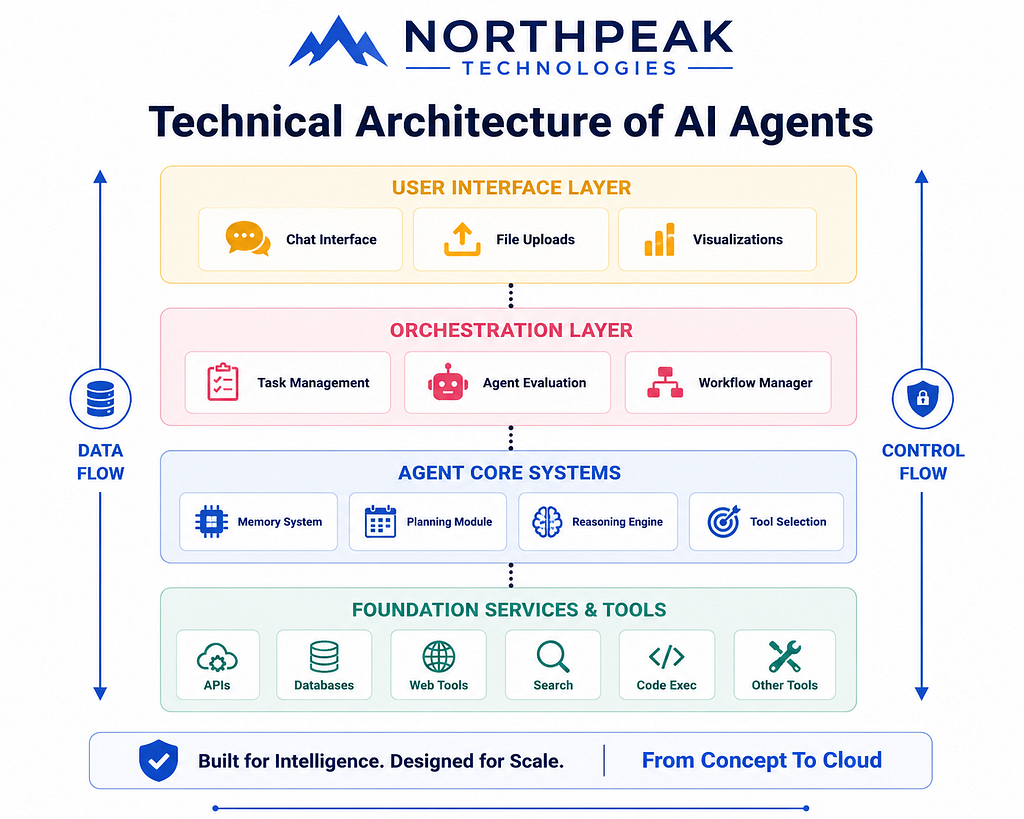
When you evaluate the technical blueprint above, notice how the User Interface Layer is no longer a monolithic destination. Instead, it is a thin, flexible viewport sitting at the top of a deep stack. The true work happens in the Orchestration Layer (managing tasks and evaluation loops) and the Agent Core Systems (which house the memory systems, planning modules, and tool selection engines).
In a JIT-UI ecosystem, the user doesn’t navigate a maze of tabs to book a flight, update a CRM, or generate an invoice. The user expresses an intent via voice, text, or ambient context.
The underlying agent core selects the necessary web tools and databases, handles the multi-step reasoning, and instructs the interface layer to dynamically render only the specific visualizations or action controls required at that exact second. Once the task is complete, that interface disappears. The app doesn’t exist until you need it.
2. From “One-Shot” Chatbots to Cognitive Systems
Many leaders assume this shift is just a fancy iteration of the conversational wrappers we saw a couple of years ago. That misconception is why so many basic automation strategies are stalling out.
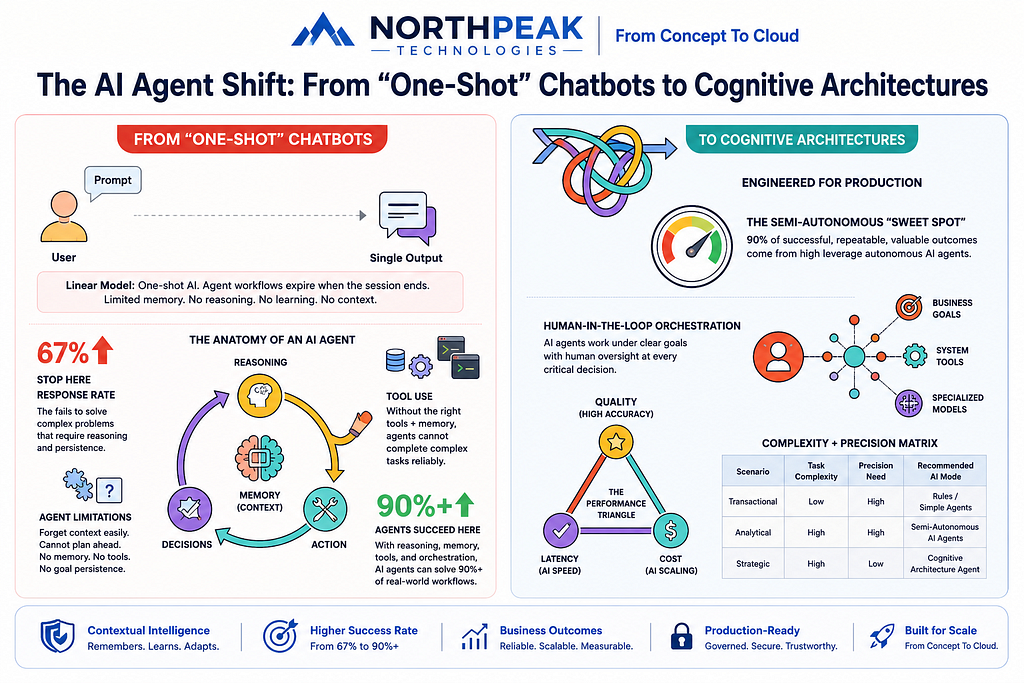
Look closely at the metrics and structures illustrated in this system roadmap. The era of the “One-Shot” chatbot is a low-yield game, capping task accuracy at roughly 67%. The breakthroughs of 2026 occur on the right side of the diagram: Cognitive Architectures running Hub-and-Spoke Orchestration.
Instead of a single, generic prompt loop trying to guess an answer, a supervisor agent coordinates a network of specialized workers (Research, Coding, Testing, Deployment). By moving to this collaborative multi-agent model, system success rates jump past 90%.
This isn’t about chatting with a bot; it is about deploying an interconnected, self-correcting engine that handles complex, long-horizon operational objectives autonomously.
3. The Paradigm Matrix: Comparing the Eras
The transition to an agent-first world redefines every baseline metric of product development. If your team is still optimizing for the left column, your overhead will soon become unsustainable.
Primary Interaction
App Era: Users navigate menus, click buttons, and manually complete workflows.
Agent-First Era: Users express intent, while AI agents determine and execute the required steps.
UI Lifecycle
App Era: Interfaces are static, pre-built, and always present.
Agent-First Era: Interfaces are generated dynamically when needed and disappear after the task is completed.
Data Flow
App Era: Request → Response.
Agent-First Era: Continuous feedback loops between users, agents, and systems.
Integration Moat
App Era: Closed ecosystems and proprietary APIs.
Agent-First Era: Open interoperability through standards like MCP.
Core Value Metric
App Era: Maximize page views and time spent.
Agent-First Era: Maximize task completion speed and user outcomes.
“The ultimate interface is no interface at all. The value of software is no longer measured by how long you can keep a user staring at a screen, but by how effectively you can execute their intent in the background.”
4. Re-Engineering Your Stack for Just-in-Time Delivery
Transitioning your enterprise infrastructure to thrive in an app-less environment requires radical architectural discipline. At NorthPeak Technologies, we don’t build fragile wrappers that rely on temporary hype cycles. We help visionary founders build the production-ready, highly resilient frameworks required to power the modern digital economy.
To ensure your system can dynamically serve data and interface blocks to autonomous agent networks seamlessly, your technology roadmap must prioritize three core pillars:
Server-Driven UI Components
Your frontend can no longer be a rigid bundle of static code. Your architecture must leverage modular, type-safe design systems where interface fragments are delivered as clean JSON schemas from the backend. This allows an orchestrating agent to assemble, style, and render a high-contrast, functional UI block on the fly based on user intent.
Flawless Schema and API Governance
If an AI agent cannot instantly read, interpret, and trust your system endpoints, your platform is invisible. True production-readiness requires strict API definitions, structured OpenAPI documentation, and automated testing pipelines. We treat your system schemas as your primary business asset.
Rigid Cryptographic Verification
When software moves from human clicks to autonomous intent execution, trust becomes a technical metric. Every dynamic UI component and agentic handoff we design at NorthPeak features deep, cryptographic verification. We ensure that your data transitions are secure, your history is auditable, and your technical sovereignty remains absolute.
The Bottom Line
The digital world is graduating from the constraints of the screen layout. The future belongs to the teams who stop building heavy software destinations and start engineering the clean data structures, modular APIs, and robust cognitive architectures that allow intelligence to flow freely.
Stop designing static pixels. Start orchestrating dynamic capabilities.
Is your product architecture built to survive the app-less evolution? At NorthPeak Technologies, we build the high-performance, resilient, and cutting-edge cloud infrastructure required to lead the modern economy. Let’s design your foundation.
https://www.northpeaktechnologies.com/
Ready to Build Your Product?
Book a free consultation. We'll review your idea and give you a clear roadmap to launch — in 4 weeks, not 4 months.