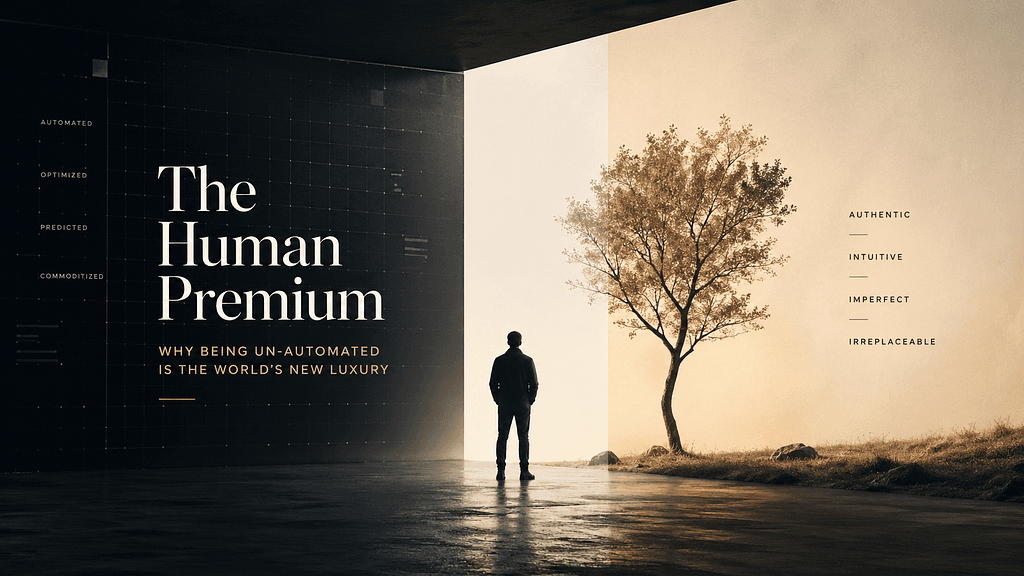
The “Human Premium”: Why Being Un-Automated is the World’s New Luxury
The “Human Premium”: Why Being Un-Automated is the World’s New LuxuryBy April 2026, the “Agentic Web” has achieved something remarkable: it has made perfection boring.Your AI agents now filter your...
 NorthPeak Technologies
By April 2026, the “Agentic Web” has achieved something remarkable: it has made perfection boring.
Your AI agents now filter your emails, optimize your calendar, and even pre-select your purchases before you know you need them. But in a world where everything is optimized, frictionless, and “perfect,” we are witnessing the rise of the Human Premium — the surging market value of things that cannot be computed.
The Commodity of “Perfect”
For the last two years, we’ve been obsessed with efficiency. We used AI to write faster, code quicker, and automate every “annoying” touchpoint of the customer journey. We succeeded.
But there’s a catch. When everyone has access to the same high-level intelligence, efficiency is no longer a competitive advantage — it’s a baseline. If a bot can write a “perfect” landing page in three seconds, that page has a market value of zero. If an agent can generate a “flawless” corporate strategy, that strategy is a commodity. In 2026, we don’t crave more “content”; we crave signal. The Search for the “Human Signal”
As AI agents increasingly mediate our choices — acting as the “Gen-engine” filters between brands and consumers — the traditional rules of SEO and marketing are dead. You are no longer competing for a spot on a Google results page; you are competing for the trust of a human who is exhausted by automation.
The most successful brands in 2026 are leaning into the “Human-Made” counter-trend. They are prioritizing:
- Radical Transparency: Showing the raw, messy process behind the product.
- Sensory Experiences: Investing in the physical, the tactile, and the in-person moments that a digital agent can’t replicate.
- Lived Expertise: Moving away from “information” (which AI owns) toward “insight” (which only humans with skin in the game can provide).
“In an era of deepfakes and automated empathy, the most radical thing you can be is authentic.”
The “Efficiency Trap”: Why We Are Redesigning, Not Just Automating
The mistake many founders made in 2025 was automating broken processes. They took a clunky customer service flow and slapped an LLM on top of it. All they did was make a bad experience faster.
The winners of 2026 are those who redesign for the human outcome. They use technology to strip away the “robotic” tasks from their staff, not to replace them, but to free them up for high-value judgment. This is the shift from Productivity to Potency.
Building for the Sovereign Individual
We are entering the age of Tech Sovereignty. Users are no longer content being the “product” for big platforms. They want to own their data, their models, and their digital identities.
If you are building a startup today, your goal shouldn’t be to “capture” an audience. It should be to empower a sovereign individual. This means building systems that are:
- Privacy-First by Architecture: Not just by policy.
- Agent-Agnostic: Designing tech that plays well with a user’s personal AI, rather than trying to lock them into your ecosystem.
- Production-Ready for Reality: Systems that don’t just work in a sandbox, but are resilient enough to handle the chaotic, un-automated world.
The Bottom Line
The future isn’t “AI vs. Human.” It’s “Human-Led, AI-Augmented.”
The highest-paid skill in the 2026 economy isn’t knowing how to prompt a model — it’s knowing what is worth building in the first place. It’s the ability to look at a sea of automated noise and find the one human truth that still resonates.
At NorthPeak Technologies, we don’t just build code; we build the infrastructure for this new reality. We help founders navigate the “Concept to Cloud” journey by focusing on the only thing that never goes out of style: Trust.
Is your product building for the automated past or the human future? Let’s build something that matters.
Ready to Build Your Product?
Book a free consultation. We'll review your idea and give you a clear roadmap to launch — in 4 weeks, not 4 months.