The Microservices Hangover: Why AI Agents Are Forcing a Return to the Monolith
For the last ten years, software engineering teams operated under a singular, unchallenged assumption: if you want to scale to millions of users, you have to break your application into...

 NorthPeak Technologies
For the last ten years, software engineering teams operated under a singular, unchallenged assumption: if you want to scale to millions of users, you have to break your application into microservices. We carved up our codebases, spun up independent teams, and gave every domain its own isolated database.
But by mid-2026, the technology landscape has encountered a massive computational shifts. We aren’t just processing static human requests anymore; we are orchestrating autonomous multi-agent networks that continuously think, iterate, and loop in the background.
And under the weight of these agentic workflows, our beautifully decoupled microservices are grinding to a halt.
Welcome to the great architectural reckoning of 2026: The Re-Monolithization of Tech.
The Distributed Everything Era is Cracking
To understand why the industry is sprinting backward toward unified architectures, we have to look at the structural trade-off we made over the last decade.
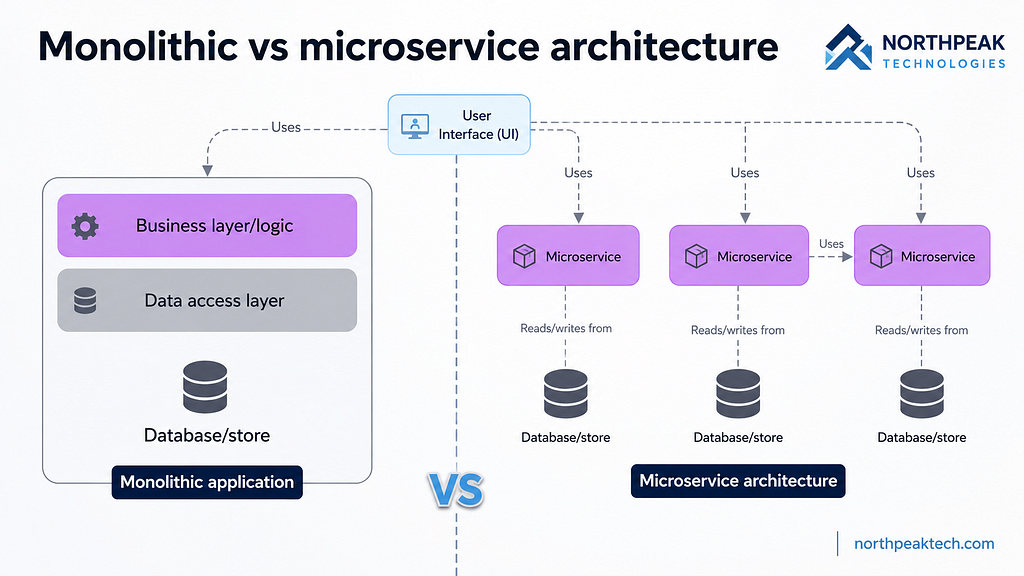
When you evaluate the standard architectural split, the microservice model on the right looks incredibly elegant on paper. Each Microservice operates independently, executing its own Business layer/logic, handling its own Data access layer, and writing to an isolated Database/store.
For a human-driven web app, this is fine. A user clicks a button, a single microservice processes the request, updates its database/store, and returns a response. The network latency of that single hop is negligible.
But watch what happens when an autonomous AI agent steps into the driver’s seat.
An agent doesn’t make one request; it executes a loop. It reads data from a user context, queries a financial module, checks an inventory system, runs a vector evaluation, and synthesizes an outcome. In a microservices layout, that single automated intent requires dozens of internal network hops across isolated services.
Suddenly, your system spends 80% of its execution time handling network latency, distributed serialization, and database synchronization hell. The infrastructure cost explodes, and the real-world performance plummets.
The Network is the New Bottleneck
In the “Year of Agentic Reality,” speed is no longer just about your CPU cycles — it is about your memory bus. When an agent requires ultra-low latency to loop through an inference pipeline, crossing network boundaries to fetch data from three separate databases is a fatal design flaw.
Distributed systems introduce three silent killers to agentic workflows:
- The Inconsistency Tax: Agents require absolute, real-time data accuracy. If a customer-service agent updates a record in Microservice A, but Microservice B’s database/store hasn’t synchronized yet due to eventual consistency, the agent operates on stale information and hallucinates.
- The Dependency Death Spiral: If one small service in your distributed chain experiences an infrastructure blip or a rate-limit lockout, your entire background multi-agent sequence fails mid-flight.
- The Cognitive Load on Developers: When your codebase is shattered across fifteen separate repositories, debugging an automated loop that behaves unpredictably becomes an impossible game of tracing logs across the cloud.
“Complexity is the premium you pay for scale you don’t actually have. In 2026, true scale happens inside a unified memory space, not across an unoptimized network.”
The Rise of the Modular Monolith
The smartest engineering teams aren’t going back to the messy, legacy “spaghetti code” monoliths of the 2000s. Instead, they are adopting the Modular Monolith — often managed inside a highly organized, single-repository monorepo structure.
By keeping your Business layer/logic and Data access layer grouped together in a unified codebase while pointing to a high-performance, single database/store engine, you eliminate the network boundary completely.
- In-Memory Velocity: Your background agents can communicate across functional modules using ultra-fast, in-memory function calls rather than heavy HTTP or gRPC network handshakes.
- ACID Transactions by Default: You regain absolute data consistency. If an agent triggers an atomic operation across billing and user profiles, it either succeeds entirely or fails cleanly — no messy distributed rollbacks required.
- Unified Engineering Velocity: Your team can leverage advanced, type-safe TypeScript ecosystems, high-performance runtimes, and single-package managers. A single developer can refactor an entire multi-step automated workflow in minutes because the entire system lives under one roof.
The NorthPeak Approach: Innovate the Product, Not the Plumbing
At NorthPeak Technologies, we refuse to over-engineer solutions to chase architectural hype. When we partner with founders to navigate the journey from Concept to Cloud, our guiding principle is Production-Ready Permanence.
We help companies build durable systems that scale efficiently without sinking capital into unnecessary infrastructure complexity:
- Architectural Clarity: We design modular monoliths that keep your codebase highly structured and distinct, ensuring you can split out a service in the future only if a genuine computational bottleneck demands it.
- Inference Economics Optimization: We structure your data pipelines so your background agents can access a single, highly optimized source of truth instantly, drastically lowering your compute overhead and cloud runtime expenses.
- Technical Sovereignty: We deliver clean, minimalist, and highly resilient systems that your team can easily understand, maintain, and scale for the long haul.
The Bottom Line
The era of splitting codebases just to look “modern” is officially over. The compute demands of modern software require a return to architectural discipline, tight data coupling, and lightning-fast local execution.
Stop building distributed labyrinths for your technology to get lost in. Build a solid, cohesive foundation that allows your vision to run at full speed.
Is your software architecture holding your product back from true scale? At NorthPeak Technologies, we engineer the high-performance, resilient, and cutting-edge cloud infrastructure required to lead the modern digital economy. Let’s build your foundation.
https://www.northpeaktechnologies.com/
Ready to Build Your Product?
Book a free consultation. We'll review your idea and give you a clear roadmap to launch — in 4 weeks, not 4 months.