The Non-Human Identity Crisis: Why the Biggest Security Threat in 2026 Doesn’t Have a Username or…
The Non-Human Identity Crisis: Why the Biggest Security Threat in 2026 Doesn’t Have a Username or PasswordRight now, inside your production environment, a silent power shift has occurred.If you audit...
 NorthPeak Technologies
The Non-Human Identity Crisis: Why the Biggest Security Threat in 2026 Doesn’t Have a Username or Password
Right now, inside your production environment, a silent power shift has occurred.
If you audit your network directories today, you will discover that human employees are now a minority. In mid-2026, the explosive adoption of autonomous AI agents, multi-cloud microservices, and automated webhooks has caused Non-Human Identities (NHIs) to outnumber human users by a ratio of greater than 20-to-1.
We spent decades perfecting security protocols for humans. We enforced multi-factor authentication (MFA), banned weak passwords, and trained staff to spot phishing emails. But while we were guarding the front door, we left the back door wide open to a vast, unmanaged ecosystem of API keys, tokens, and service accounts.
Welcome to the Identity Liquidation Crisis of 2026.
1. The Exponential Explosion of Machine Keys
For years, a “user” was a person with an email address and a job title. When that person left the company, IT revoked their access, and the perimeter remained safe.
Today, every automated workflow you deploy spins up its own set of credentials. When a developer hooks an AI subagent into a GitHub repository, or connects an internal database to a cloud analytics tool, a non-human identity is born. These machine credentials bypass traditional access controls completely. They don’t log in through a corporate dashboard, they don’t have biometrics, and they never sleep.
The core architectural flaw of modern software deployment is treating these high-privilege service connections as temporary “plumbing” rather than permanent, high-risk infrastructure.
2. Why Human-Centric Security Fails Machine Reality
The traditional security frameworks that enterprises rely on are fundamentally unequipped to manage machine access. Humans operate within predictable boundaries; machines operate with superhuman speed and infinite persistence.
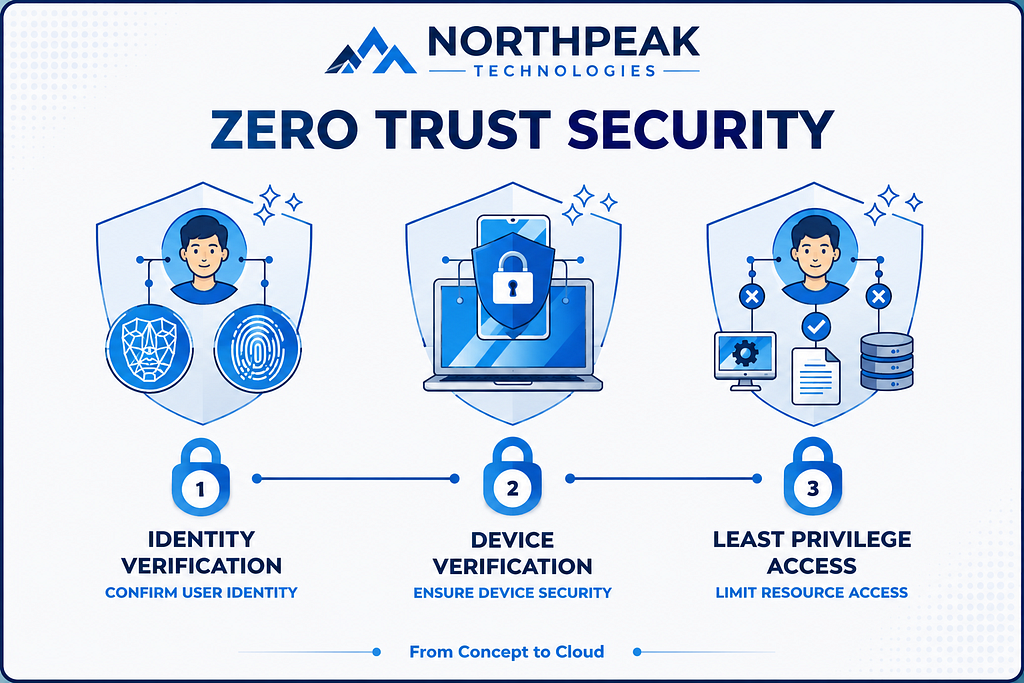
When you evaluate the standard security model depicted in the diagram above, the strategy relies on a linear validation process: Identity Verification, Device Verification, and Least Privilege Access. For a human engineer sitting at a laptop, confirming identity through a biometric prompt or a hardware token is straightforward.
But how do you apply this to an autonomous AI subagent executing a real-time data synthesis loop?
- You can’t send an MFA prompt to an automated background worker.
- You can’t verify the physical device location of an ephemeral cloud function that exists for only three seconds.
- You can’t easily enforce least privilege when a machine needs broad, cross-service permissions to fetch data across isolated legacy databases.
Because these credentials lack a human gatekeeper, they become the path of least resistance for modern cyber threats. If an attacker compromises a single unrotated API key buried deep within a forgotten development environment, they gain static, unmonitored access to your entire cloud core.
3. The Anatomy of a Non-Human Identity Breach
The primary vector for major enterprise breaches this year is no longer social engineering or stolen employee passwords. It is Credential Secret Sprawl.
A junior developer uses a code generator to build a quick integration. The AI assistant quietly hard-codes an access token into a configuration file. That file is accidentally pushed to a private repository. An automated scraper finds it within minutes.
Because the compromised credential belongs to a service account rather than a human, standard behavioral monitoring tools don’t raise an alarm. The attacker can exfiltrate data, mutate database schemas, or hijack compute resources for months without triggering a single password-reset flag.
“A security perimeter is only as strong as its most forgotten integration. In 2026, you aren’t just vulnerable through your staff; you are vulnerable through your scripts.”
4. Implementing Zero-Trust for Machine Architectures
To secure a highly automated, agentic architecture, enterprises must evolve their infrastructure from a human-first model to a Comprehensive Security Mesh. Security can no longer be an afterthought added during the pre-deployment checklist; it must be baked directly into the system’s DNA.
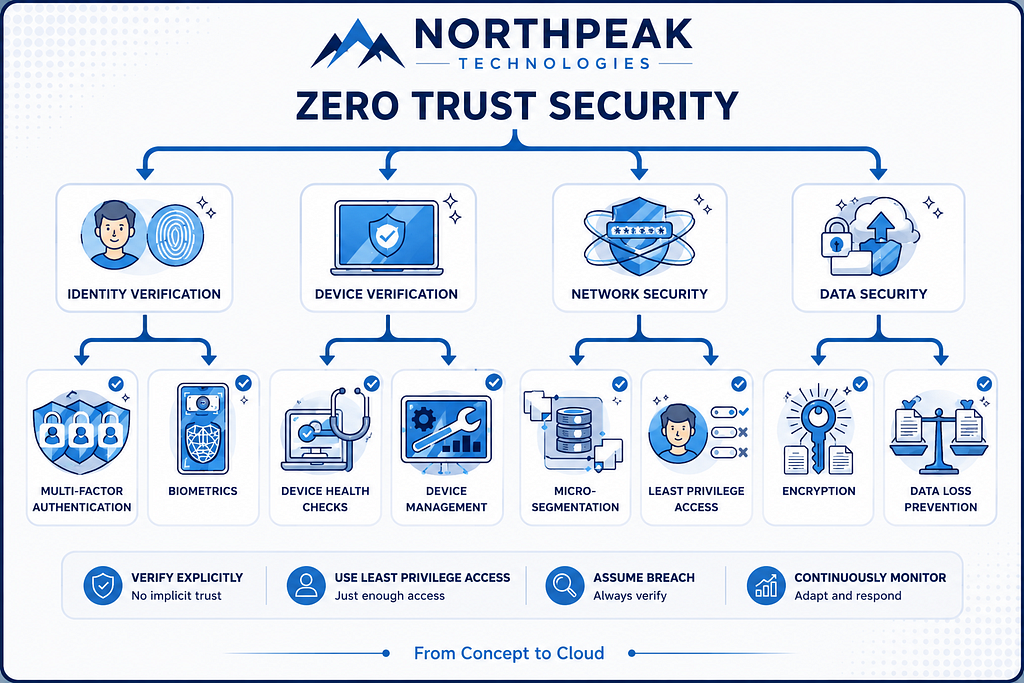
As illustrated in this detailed security layout, a modern, production-ready system requires a synchronized approach across four distinct architectural vectors: Identity Manipulation, Device Verification, Network Security, and Data Security.
To transition your infrastructure to handle non-human identities securely, your technical roadmap must enforce three foundational rules:
- Short-Lived Ephemeral Credentials: Stop issuing static, everlasting API tokens. Machine connections must utilize dynamic, time-bound tokens that automatically expire and rotate every few minutes via automated secret vaults.
- Machine-to-Machine Micro-Segmentation: Isolate your services completely. A customer-facing UI agent should never have a direct database connection string; it must communicate via cryptographically signed webhooks and strictly authenticated micro-gateways.
- Non-Human Behavior Analytics: Implement monitoring tools specifically designed to track machine behavior. If an automated script suddenly starts downloading data volumes greater than 300% of its daily baseline, the system must trigger an immediate, programmatic lockdown.
5. The NorthPeak Blueprint: Technical Sovereignty Over Hype
At NorthPeak Technologies, we refuse to participate in the “move fast and break things” mentality that dominates the current technology wave. We understand that in an economy powered by autonomous software and cloud scale, security and architecture are the exact same thing.
When we lead founders and enterprises from Concept to Cloud, we engineer systems built for long-term stability and absolute resilience:
- Zero-Trust Engineering by Default: We build monorepos and distributed systems with hardened, hardware-bound machine authentication layers from the very first line of code.
- Radical Structural Cleanliness: We eliminate secret sprawl by implementing highly optimized, type-safe environment configurations and containerized isolation fields.
- Strategic Honesty: If your tech team is pushing a fast feature launch while ignoring your non-human identity footprint, we will challenge those assumptions directly. We prioritize your long-term technical sovereignty over short-term vanity metrics.
The Bottom Line
The digital ecosystem is growing larger, faster, and more autonomous by the hour. The companies that will survive the late 2020s are those that recognize that governance belongs to the machines just as much as the humans.
Stop managing your infrastructure like it’s 2018. Protect your assets, audit your service accounts, and build a foundation that can withstand the real-world scale of tomorrow.
Is your technology stack truly secure against modern machine threats? At NorthPeak Technologies, we construct clean, high-performance, and deeply robust enterprise solutions that bridge the gap between complex technical ideas and resilient realities. Let’s fortify your infrastructure.
https://www.northpeaktechnologies.com/
Ready to Build Your Product?
Book a free consultation. We'll review your idea and give you a clear roadmap to launch — in 4 weeks, not 4 months.