The Orchestration Era: Why Monolithic AI Models Are Losing to Multi-Agent Networks
If you are still trying to build your business value around a single, massive frontier model, your product strategy is already obsolete.By mid-2026, the technology landscape has completed a massive,...
 NorthPeak Technologies
If you are still trying to build your business value around a single, massive frontier model, your product strategy is already obsolete.
By mid-2026, the technology landscape has completed a massive, silent paradigm shift. The race to build a slightly larger, all-knowing neural network has hit diminishing returns. Instead, the global tech industry has entered The Orchestration Era — a new computational reality where enterprise value isn’t created by a single model doing everything, but by highly coordinated networks of specialized, autonomous agents interacting in real time.
If you want to achieve global scale this year, you must stop building “wrappers” and start orchestrating Multi-Agent Systems (MAS).
The Computational Wall of the Lone AI Agent
In the initial wave of enterprise AI adoption, organizations deployed standalone models to tackle distinct, linear workflows. A user interacted with a single chatbot interface, which processed data from a vector store, hit a basic LLM reasoning layer, and returned an output.
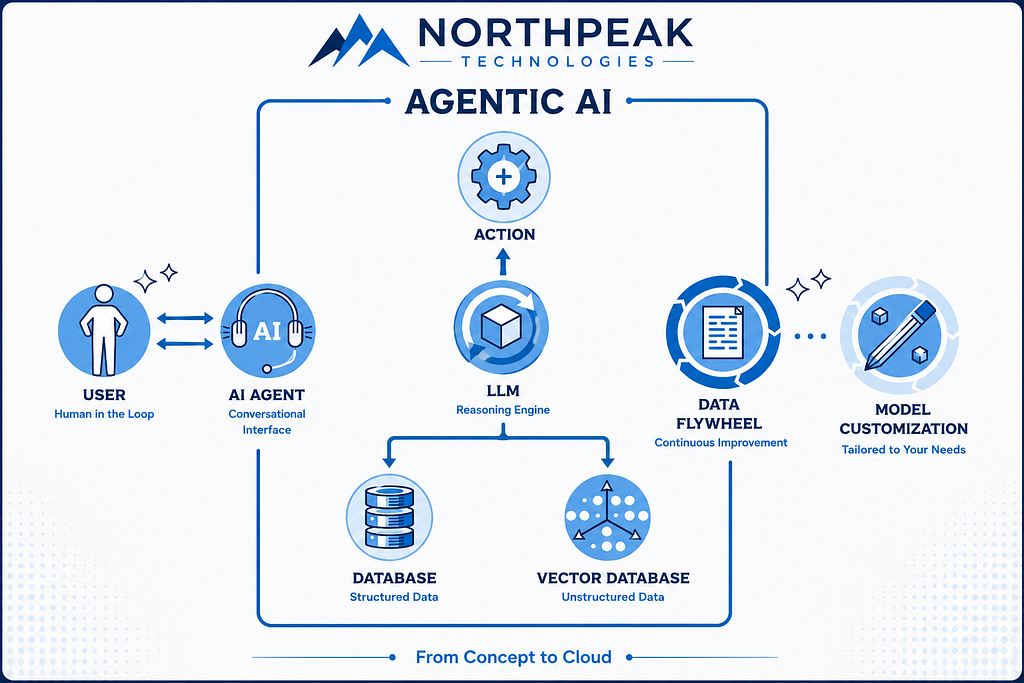
When you evaluate the standard standalone setup above, notice the tight, centralized coupling. The User communicates with a dedicated AI Agent, which uses an underlying LLM to drive an Action pipeline. To stay grounded, this loop queries a traditional Database and a specialized Vector Database, cycling through a continuous Data Flywheel for ongoing Model Optimization.
While this linear process works beautifully for isolated tasks like customer support triage or automated document summaries, it crumbles when applied to cross-functional enterprise workflows.
A single central reasoning unit has a massive cognitive bottleneck: it must balance context window saturation, system prompt dilution, and execution latency all at once. Forcing one massive model to handle data ingestion, threat analysis, financial modeling, and executive reporting doesn’t create efficiency — it creates massive systemic drag.
The Distributed Shift: Coordinated Specialization
To bypass this bottleneck, the global engineering consensus in 2026 has shifted from a centralized architecture to a Distributed and Collaborative Process.
Instead of expecting one model to be a master of all trades, we break down complex enterprise operations into specific, modular agent roles that execute tasks in parallel.
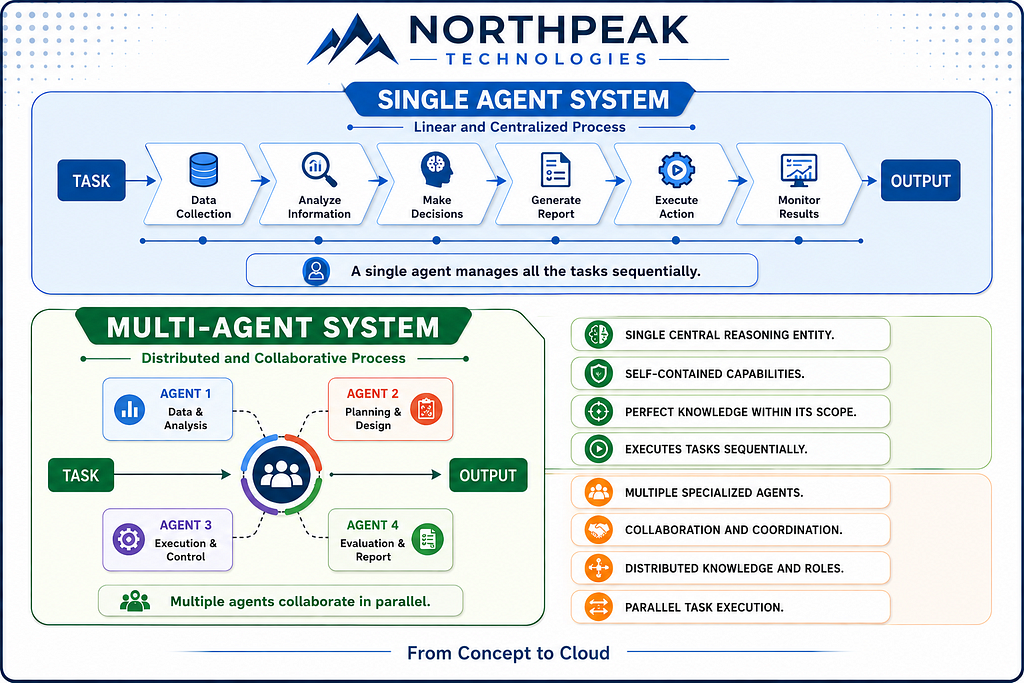
Look at the structural shift illustrated in this engineering blueprint. In a Single Agent System, the workflow is a linear, centralized pipeline: Data Collection leads to Analyze Information, Data Validation, Generate Report, Ensure Logic, and finally, Review Quality. A single agent manages all these tasks sequentially.
Now, look at the Multi-Agent System on the bottom left. The architecture transitions into a parallel, interconnected web where multiple specialized agents collaborate simultaneously:
- Agent 1 (Data & Analysis): Specializes entirely in real-time data ingestion and anomaly detection.
- Agent 2 (Planning & Design): Maps out structural workflows and cross-checks system constraints.
- Agent 3 (Execution & Metrics): Fires API webhooks and commits operations across external infrastructure.
- Agent 4 (Validation & Report): Audits outputs, verifies logic against compliance guardrails, and signs off on the quality.
Because these specialized nodes communicate using open interoperability standards (like MCP and A2A communication frameworks), they can complete complex, multi-step actions in parallel with 90% less token waste and near-zero context dilution.
“True intelligence isn’t a massive, monolithic brain trying to hold the entire world in memory. True intelligence is a perfectly conducted orchestra.”
Rebuilding Your Infrastructure for Multi-Agent Scale
Moving your product from a single prompt loop to a production-ready multi-agent network requires a complete re-evaluation of your engineering stack. At NorthPeak Technologies, we assist founders and enterprises in navigating this shift cleanly, bypassing the architectural hype to build durable, hyper-efficient cloud ecosystems.
If you are engineering a multi-agent platform to handle real-world global scale in 2026, your technical blueprint must implement three core foundations:
1. State Persistence and Unified Memory
When autonomous subagents are tossing execution tokens back and forth, they cannot operate in isolation. You must build an independent, hyper-reliable state management layer. If Agent 1 modifies a data payload, that state change must update instantly across a type-safe, unified database registry so that Agent 4 doesn’t run its validation checks on stale context.
2. Micro-Orchestration over Hard-Coded Chains
Stop hard-coding your agent interactions with rigid, nested conditional statements. If you build a fixed pipeline where Agent A must talk to Agent B via a static function call, you are just building distributed spaghetti code. Use decoupled, event-driven message brokers where agents publish state changes and subscribe to intents dynamically.
3. Rigid Programmatic Guardrails
An autonomous multi-agent network should never operate unchecked. True Production-Ready systems require strict, non-AI programmatic validation layers between agent boundaries. If an agentic loop is authorized to update financial structures or alter cloud infrastructure, the final execution must be gated by immutable validation schemas and human-in-the-loop cryptographic handshakes.
The Bottom Line
The era of evaluating AI capability purely by model size is officially over. The competitive moat of 2026 belongs to the architects who can coordinate multiple specialized intelligences into a single, cohesive, and resilient enterprise system.
Stop trying to build a bigger engine. Start building a better framework.
At NorthPeak Technologies, we build clean, high-performance, and forward-compatible engineering stacks that turn complex technical concepts into robust cloud realities. We cut through the noise, challenge weak assumptions, and ensure your system is built to lead the modern digital economy.
Is your product architecture built for the multi-agent evolution? At NorthPeak Technologies, we engineer the high-fidelity, secure, and cutting-edge cloud infrastructure required to scale your vision globally. Let’s map out your network.
https://www.northpeaktechnologies.com/
Ready to Build Your Product?
Book a free consultation. We'll review your idea and give you a clear roadmap to launch — in 4 weeks, not 4 months.