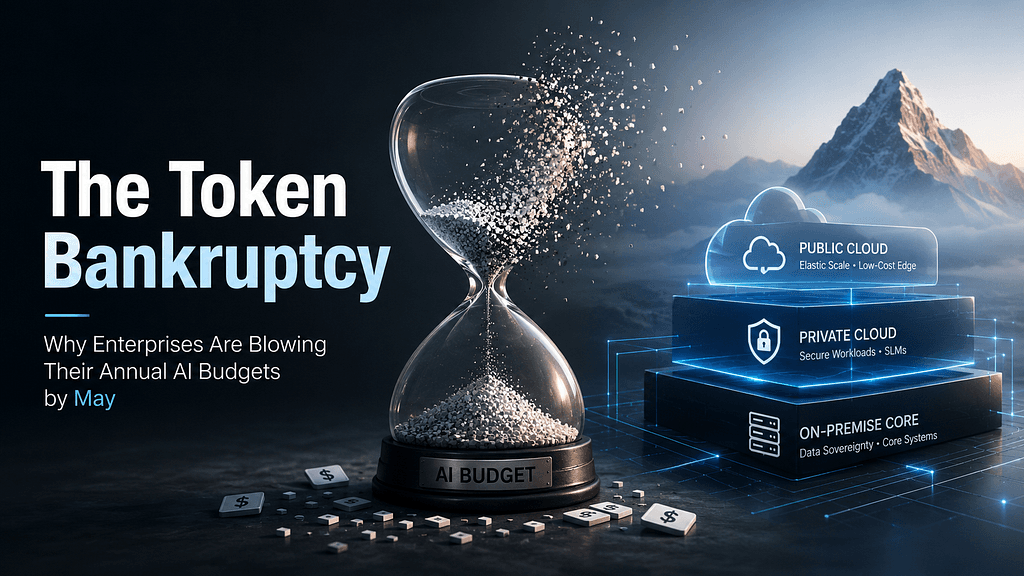
The Token Bankruptcy: Why Enterprises Are Blowing Their Annual AI Budgets by May
It was supposed to be the year of infinite efficiency.At the start of the year, boards around the world greenlit massive budgets for autonomous AI agent networks, confident that cutting...
 NorthPeak Technologies
It was supposed to be the year of infinite efficiency.
At the start of the year, boards around the world greenlit massive budgets for autonomous AI agent networks, confident that cutting human operational steps would slash long-term expenses. Instead, tech executives are experiencing a brutal awakening: companies are completely blowing through their annual AI budgets before the summer even begins.
When a single autonomous agent transitions from a simple conversational assistant to a proactive worker that loops endlessly behind the scenes, your infrastructure costs don’t scale linearly — they explode. Welcome to the Great Token Demand Shock, where the biggest operational hurdle isn’t model capability, but inference economics.
The Core Equation of Runaway Compute
To understand why your current budget is melting away, we have to pull back the curtain on how modern generative engines calculate utility. Many founders believe that because API token prices dropped significantly over the last two years, compute is practically free.
That assumption ignores how an autonomous multi-agent framework actually handles data.
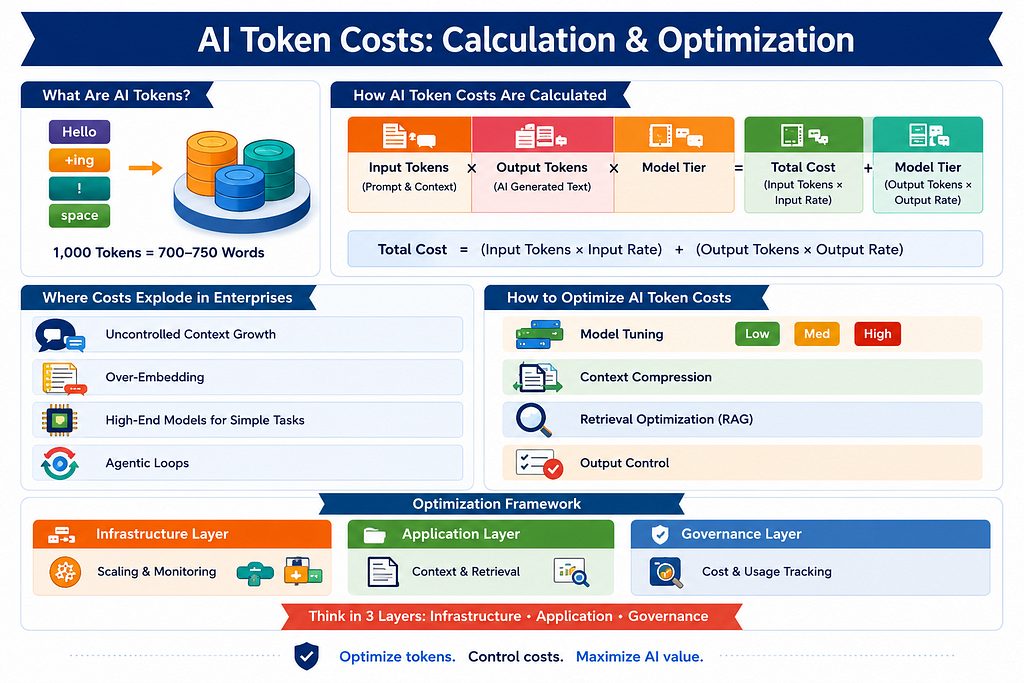
When you analyze the token calculation framework above, look closely at the section titled “Where Costs Explode in Enterprises.” It highlights four massive architectural sync-holes:
- Agentic Loops: Proactive agents running thousands of automated background tasks without human oversight.
- Uncontrolled Context Growth: Appending an entire, uncompressed historical message string or complex database schema to every single new API call.
- High-End Models for Simple Tasks: Routinely routing low-stakes tasks — like routing an internal support email or format parsing — to expensive, flagship frontier reasoning models.
- Over-Embedding: Throwing raw, unindexed document blocks into high-dimensional vector spaces without relationship routing.
In a classic software pipeline, a database query takes a few milliseconds of local processor cycles. In an agentic architecture, an autonomous loop that evaluates a single transaction might execute fifty iterative steps across a context window of 100,000 tokens. Multiply that by thousands of concurrent operations, and your financial runway disappears into the cloud.
Moving From Public Monoliths to Cloud 3.0
The solution to token bankruptcy isn’t to shut down your automation initiatives; it is to re-engineer the plumbing.
The initial wave of corporate AI adoption relied entirely on a centralized strategy: opening an account with a major third-party LLM provider, pointing a webhook at their API, and channeling every corporate data stream into their public servers. Today, that monolithic model is being replaced by Cloud 3.0: The Hybrid-Sovereign Architecture.
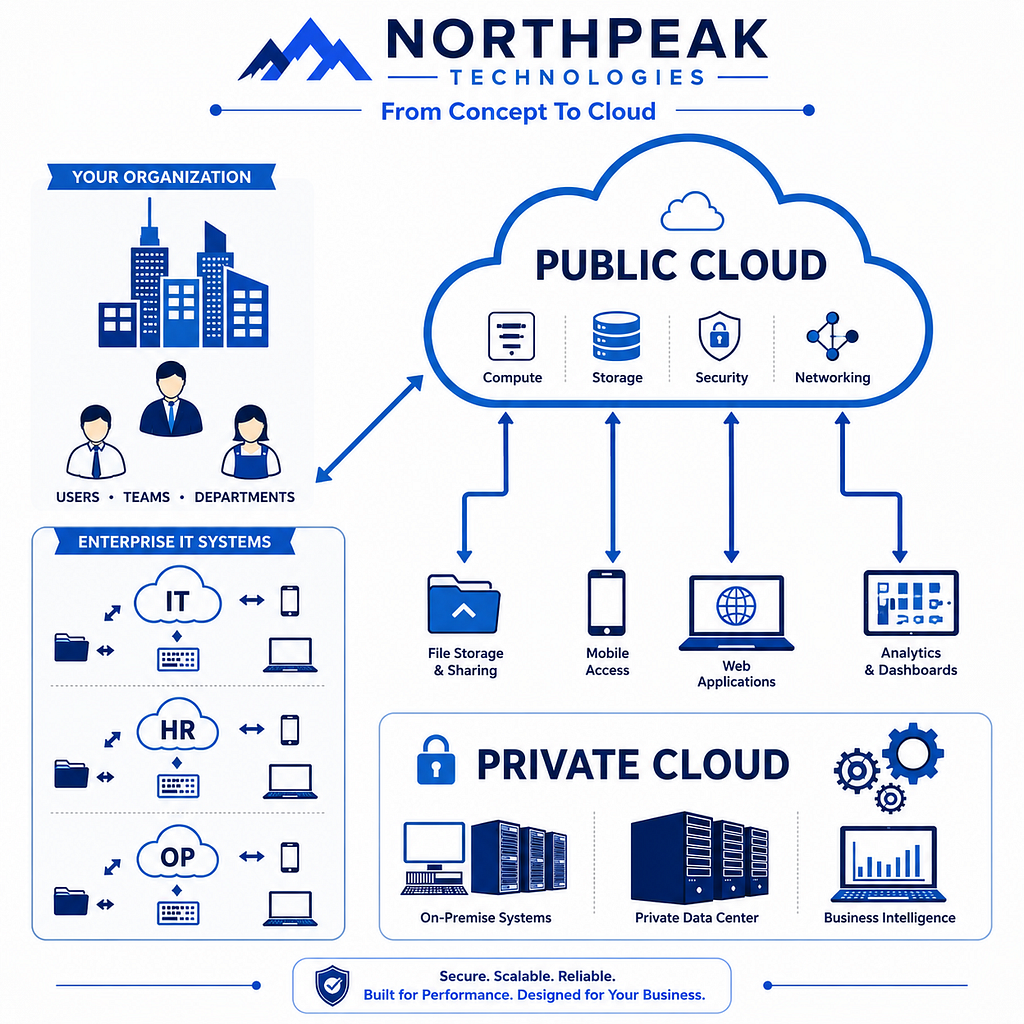
As illustrated in this cloud infrastructure blueprint, the modern enterprise must split its computational workloads across distinct, decoupled environments.
Instead of routing every operational intent to a central, public cloud monster, systems are being redesigned to keep their core data vaults and specialized Small Language Models (SLMs) locked safely inside Private Cloud or On-Premise Core frameworks. The Public Cloud layer is utilized exclusively for what it does best: elastic, high-velocity edge distribution and handling low-stakes, low-cost multimodal interfaces.
By running highly optimized, custom-tuned open-source models on private, dedicated infrastructure, you eliminate the variable token tax completely. You pay for the hardware footprint, not the syllable count.
“Throwing raw compute at a broken process doesn’t make it efficient; it just makes your failure incredibly expensive. True technical scale is a game of architectural optimization, not brute force.”
The Blueprint for Inference-Aware Engineering
At NorthPeak Technologies, we refuse to participate in the “vibe-based” engineering trends that lead directly to budget collapses. When we partner with founders to navigate the technical journey from Concept to Cloud, we treat compute efficiency as a core architectural constraint from the very first line of code.
To ensure your digital platform achieves massive global scale without triggering financial ruin, your development roadmap must implement three non-negotiable foundations:
1. Dynamic Model Tiering
Stop using a flagship frontier model to categorize a checkbox. A production-ready system requires a multi-layered model routing framework. Low-complexity tasks should automatically route to fast, cost-efficient edge networks, while massive, expensive reasoning models are woken up only when a high-stakes, multi-step strategic decision demands their cognitive weight.
2. Context Compression and Semantic Layering
Feeding raw, unorganized document chunks into a large context window is an architectural failure. We implement advanced semantic layers and explicit graph schemas that structure your data before an agent ever requests it. By serving compressed, high-density context packets, we lower token waste by greater than 40% while completely protecting your platform from hallucinations.
3. Strict Algorithmic Governance
Autonomous agents cannot run unchecked. True operational maturity requires deterministic, non-AI guardrails built beneath your application layer. If an agent enters an infinite loop or starts executing redundant tasks, programmatic “kill switches” must immediately pause the workflow, log the trail for human evaluation, and secure the infrastructure budget.
The Bottom Line
The era of effortless, unoptimized cloud spending is officially over. Technology leadership is no longer about showing off a flashy, automated prototype; it is about building the durable, efficient, and cost-predictable engines that actual businesses run on.
Stop letting your software autocompleting your operating budget. Build a foundation that values your capital as much as your capabilities.
If your current technical team is building applications without an explicit strategy for inference economics and architectural sovereignty, they aren’t building an asset — they are building a liability. Let’s design a system that lasts.
Is your product architecture built to survive the realities of the token economy? At NorthPeak Technologies, we engineer clean, high-performance, and truly Production-Ready cloud solutions that align technical excellence with long-term business value. Let’s map out your foundation.
https://www.northpeaktechnologies.com/
Ready to Build Your Product?
Book a free consultation. We'll review your idea and give you a clear roadmap to launch — in 4 weeks, not 4 months.