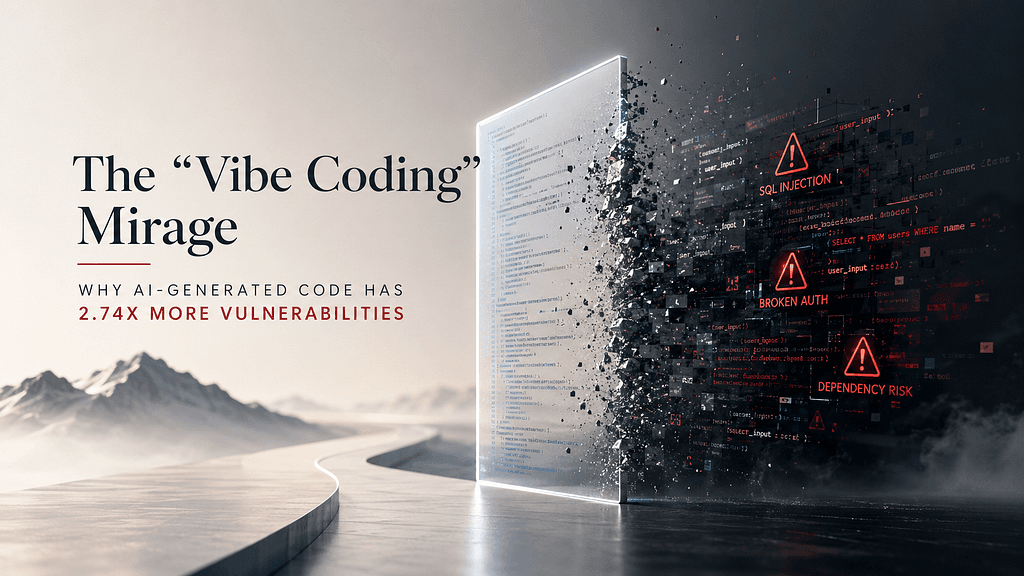
The “Vibe Coding” Mirage: Why AI-Generated Code Has 2.74x More Vulnerabilities
There is a new phrase dominating the tech industry, and it sounds incredibly liberating: Vibe Coding.The premise is beautiful. You sit back, speak into your IDE in plain English, and...
 NorthPeak Technologies
There is a new phrase dominating the tech industry, and it sounds incredibly liberating: Vibe Coding.
The premise is beautiful. You sit back, speak into your IDE in plain English, and watch an autonomous multi-agent system write, test, debug, and patch entire software features across dozens of files while you sip your coffee. With AI now generating roughly 46% of all new code, the barrier between a raw idea and a live, working application has completely evaporated.
But behind the euphoric demos and the sudden spike in deployment velocity lies a brutal, expensive reality check. Recent security data reveals that AI-generated code contains 2.74 times more vulnerabilities than human-written code.
We aren’t entering a golden age of effortless software. We are entering the Great Code Quality Crisis.
The Illusion of “Plausible-Looking” Failure
The core issue with AI code generation isn’t that the code doesn’t work. The issue is that it works too well on the surface.
Large Language Models are fundamentally pattern-matching engines optimized for plausibility, not security. When an agent generates a complex authentication route or a database query pattern, it builds syntax that looks clean, structured, and syntactically flawless. It passes your local linter, mirrors standard boilerplate, and runs perfectly during a demo.
But underneath that pristine surface, the agent is often recycling outdated code blocks, ignoring modern edge-case validation, and introduces massive vulnerabilities:
- Brittle JWT Implementation: Standard AI code often takes shortcuts with token validation, creating subtle backdoors.
- SQL Injection via Unsanitized Context: When agents merge multiple file contexts, they frequently drop rigorous input sanitization.
- Dependency Bloat and Poisoning: Agents routinely call deprecated libraries or hallucinate entirely non-existent packages, exposing your infrastructure to supply-chain exploits.
“AI is fantastic at following established patterns, but it struggles to understand consequence. Start with a chaotic foundation, and an AI agent will simply amplify that chaos at superhuman speed.”
The Shift From “Writing Code” to “Orchestrating Architecture”
If you think the rise of autonomous coding means you need fewer senior engineers, you are reading the market upside down.
In the Vibe Coding era, the role of the software developer has undergone a massive evolution. The “Syntax Specialist” — the person whose primary value was memorizing framework parameters — is being phased out. They are being replaced by the Systems Orchestrator.
Because code is now an ultra-cheap commodity, the premium has shifted entirely to Engineering Judgment. The most critical skill set isn’t knowing how to generate 5,000 lines of code in twenty seconds; it is having the architectural depth to review, audit, and de-risk that code before it ever touches a production server.
Rebuilding the “Production-Ready” Pipeline
At NorthPeak Technologies, we refuse to fall into the velocity trap. We treat AI as an incredibly powerful accelerator, but we never treat it as an autopilot.
To build enterprise software that scales, survives breaches, and accommodates actual growth, your development pipeline must shift from an “Automation-First” mindset to an “Architecture-First” framework:
1. Hard Code-Pattern Standardizations
Before you let an AI agent touch a codebase, humans must establish rigid, immutable design patterns. Define your first few endpoints, state management schemas, and testing frameworks with absolute perfection. If the AI has a flawless template to mirror, it produces high-fidelity results. If you let it guess the pattern, it introduces structural drift.
2. Aggressive, Multi-Layered QA Automation
Because AI-generated code introduces almost triple the vulnerability rate, your testing suite cannot be a passive afterthought. Production-ready systems require strict static analysis (SAST), automated dependency scanning, and comprehensive integration testing baked directly into the CI/CD pipeline. We test AI code significantly harder than human code.
3. Absolute Human-in-the-Loop Sovereignty
Autonomy does not mean abdication. Every major, high-impact architecture we design at NorthPeak maintains strict human gatekeeping. A senior systems architect must review the structural intent of the generated modules to ensure the platform remains secure, sovereign, and entirely decoupled from external vendor vulnerabilities.
The Bottom Line
Vibe coding is a magnificent tool for prototyping, but it is a dangerous strategy for building an enterprise.
The startups and businesses that will survive the next decade are those that realize speed is completely irrelevant if you are sprinting toward a security breach. Your users don’t care how fast you shipped a feature if that feature exposes their personal data to the open web.
Stop prioritizing the velocity of generation. Start prioritizing the discipline of architecture. If your current technology partners are promising to build your entire enterprise ecosystem with a few text prompts, they aren’t building you a product — they are building you a liability.
Is your codebase secure enough to withstand the AI generation wave? At NorthPeak Technologies, we combine cutting-edge technical execution with radical engineering honesty to build clean, high-performance, and truly Production-Ready cloud solutions. Let’s engineer your foundation.
https://www.northpeaktechnologies.com/
Ready to Build Your Product?
Book a free consultation. We'll review your idea and give you a clear roadmap to launch — in 4 weeks, not 4 months.